How Progressive Lenses Work
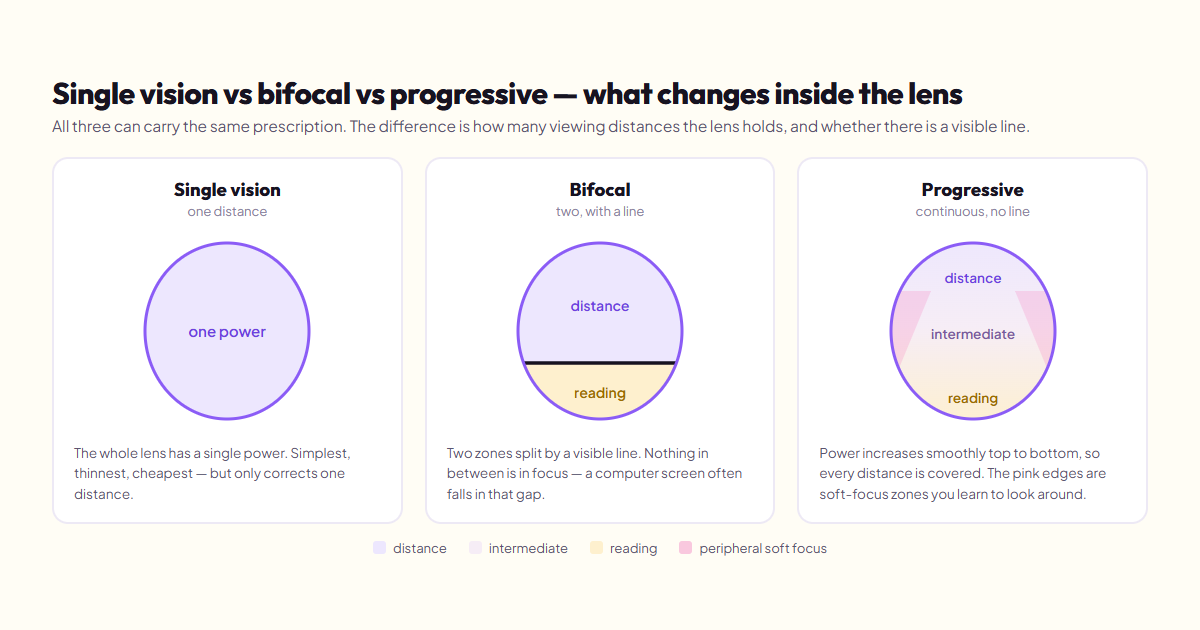
Think of progressive lenses as a smooth ramp rather than stairs. Traditional bifocals give you two distinct zones (distance and reading) separated by a visible line. Progressives eliminate that line and add a third zone in between — the intermediate zone, which is ideal for computer screens, dashboards, and arm's-length tasks.
The lens power changes gradually from the top down. Look straight ahead for distance. Drop your eyes slightly for mid-range. Look through the lower portion for reading and close work. Your brain learns to find the right zone naturally within the first couple of weeks.
The trade-off is the peripheral zones — the left and right edges of a progressive lens have mild distortion (a slight swim or blur). This is a byproduct of the optics and affects all progressive designs, though premium lenses minimize it significantly.
This is one of the most common questions that comes up during eye exams, and the answer often depends on individual factors that only a professional assessment can evaluate. What works for one person may not be ideal for another — your prescription, daily activities, facial anatomy, and budget all play a role in determining the best approach.
If you're in the Edmonton area, Charm Optical offers comprehensive eye exams that go beyond just measuring your prescription. Their optometrists assess your overall eye health, discuss your visual needs, and recommend lens and frame options tailored to your lifestyle. With direct insurance billing for most Alberta providers and same-day glasses for many prescriptions, getting the right eyewear doesn't have to be complicated or expensive. Book online — appointments are usually available within a few days.
Who Needs Progressive Lenses?
Progressives are designed for people with presbyopia — the age-related loss of near focusing ability that typically starts around age 40–45. You'll know it's happening when you start holding your phone farther away to read text, or when restaurant menus become blurry at normal reading distance.
Your prescription will include an 'ADD' power (ranging from +0.75 to +3.00 or higher) which indicates the extra magnification needed for reading. If your prescription has an ADD value, you're a candidate for progressives, bifocals, or dedicated reading glasses.
Many people choose progressives because they want one pair that handles everything — driving, computer work, and reading — without switching glasses. An eye exam at Charm Optical will determine if you need an ADD power and whether progressives are the right solution.
If you're experiencing any of these signs regularly, it's worth getting a professional assessment rather than guessing. Many vision problems develop gradually — your brain compensates for declining vision so effectively that you may not notice the change until it's significant. A comprehensive eye exam can detect issues that self-assessment misses, including early signs of conditions like glaucoma and macular degeneration that have no symptoms in their early stages.
The Canadian Association of Optometrists recommends eye exams every 1-2 years for adults. Children should be examined annually since vision problems can significantly impact learning and development. In Alberta, children under 18 receive coverage through Alberta Health. Adults with diabetes or a family history of eye disease should also get annual exams. Book an appointment at Charm Optical — they accept most Alberta insurance providers through direct billing.
Progressive Lenses vs. Bifocals vs. Reading Glasses
| Feature | Progressive | Bifocal | Reading Glasses |
|---|---|---|---|
| Vision zones | 3 (distance, intermediate, near) | 2 (distance, near) | 1 (near only) |
| Visible line | No | Yes | N/A |
| Computer use | Good (dedicated zone) | Poor (no intermediate zone) | Too strong for screen distance |
| Adjustment period | 1–2 weeks | A few days | None |
| Cost (lenses only) | $200–$600+ | $100–$250 | $10–$50 OTC |
| Appearance | Looks like regular glasses | Visible line dates the look | Separate pair needed |
Most people under 55 with presbyopia start with progressives. If you've already been wearing bifocals and they work well, there's no pressure to switch — but if you're new to multifocals, starting with progressives means you won't have to re-adjust later.
When comparing options, consider your daily routine and visual priorities rather than just price. The "best" choice is the one that matches how you actually use your eyes throughout the day. Someone who works on a computer for 8 hours has very different needs than someone who primarily drives or reads. An honest conversation with your optometrist about your daily visual demands will point you toward the right option far more effectively than online reviews.
Keep in mind that you're not locked into one choice forever. Many people own multiple pairs for different situations — dedicated computer glasses for the office, progressives for daily wear, and prescription sunglasses for driving. Charm Optical carries 500+ frames across every style and price point, making it easy to build a collection that covers all your visual needs. Their opticians can advise which lens types pair best with each frame style. Same-day glasses are available for many single vision prescriptions.
How Much Do Progressive Lenses Cost in Canada?
Progressive lens pricing varies widely based on the design quality:
- Standard/basic progressives: $200–$300 — Wider peripheral distortion, smaller reading zone. Functional but less comfortable for extended wear.
- Mid-range progressives: $300–$450 — Better peripheral clarity, wider intermediate zone. Brands like Essilor Comfort and Zeiss SmartLife fall here.
- Premium progressives: $450–$600+ — Widest fields of vision at all distances, custom-mapped to your measurements. Essilor Varilux, Zeiss Individual, Hoya iD.
These prices are for lenses only — frame costs are separate. Most Alberta insurance plans (Alberta Blue Cross, Canada Life, Great-West Life) cover a portion of progressive lenses. Charm Optical direct-bills most Alberta insurance providers, so you only pay the difference out of pocket.
Pricing varies significantly depending on where you buy and what lens features you choose. In Canada, the total cost of a complete pair of glasses (frame + lenses) typically breaks down as follows: budget options start at $150-$250 for basic frames with standard single vision lenses. Mid-range options with anti-reflective coating and a name-brand frame run $300-$500. Premium designer frames with progressive or high-index lenses can reach $600-$900+. The biggest variable is usually the lens — a basic single vision lens costs far less than a digital freeform progressive with premium coatings.
Insurance makes a significant difference. Most employer health plans in Alberta cover $200-$500 toward glasses every 1-2 years. Charm Optical direct-bills most Alberta insurance providers — Alberta Blue Cross, Canada Life, Desjardins, and more — so you only pay the difference at the counter. No paperwork, no reimbursement wait. Book an eye exam to get your prescription checked and learn exactly what your plan covers before you shop.
Tips for Adjusting to Progressive Lenses
The adjustment period is real but manageable. Here's what helps:
- Wear them full-time from day one. Switching between progressives and your old glasses resets the adaptation process.
- Point your nose, not just your eyes. To look at something to the side, turn your head rather than just moving your eyes. This keeps you in the clear central zone.
- Lower your eyes for reading, not your head. The reading zone is at the bottom of the lens — tilt your eyes down while keeping your head fairly level.
- Give stairs extra attention. The peripheral blur can affect depth perception on stairs for the first few days. Use the handrail and look through the upper (distance) part of the lens.
- Two weeks is the benchmark. If things don't feel natural after 2 weeks of full-time wear, go back to your optician. The fit or prescription may need tweaking.
At Charm Optical, they check your progressive fitting carefully and offer follow-up adjustments if the adaptation isn't going smoothly. That in-person support is one of the biggest advantages of buying progressives in-store versus online.
Choosing the Right Frame for Progressive Lenses
Frame choice matters more with progressives than single vision. The lens needs enough vertical height to fit all three zones — distance, intermediate, and reading. A frame that's too shallow cuts off the reading zone and makes the lens harder to use.
Look for frames with at least 28–30mm of lens height. Larger frames (32mm+) give you wider, more comfortable zones at every distance. Avoid very narrow or small frames unless they're specifically marked as progressive-compatible.
Your optician should also take precise measurements — pupillary distance, fitting height, and sometimes pantoscopic tilt. These measurements determine exactly where each zone sits relative to your eyes, and even small errors can make a big difference in comfort. Book an appointment at Charm Optical and their team will walk you through frame options that work well with your progressive prescription.
This is one of the most common questions that comes up during eye exams, and the answer often depends on individual factors that only a professional assessment can evaluate. What works for one person may not be ideal for another — your prescription, daily activities, facial anatomy, and budget all play a role in determining the best approach.
If you're in the Edmonton area, Charm Optical offers comprehensive eye exams that go beyond just measuring your prescription. Their optometrists assess your overall eye health, discuss your visual needs, and recommend lens and frame options tailored to your lifestyle. With direct insurance billing for most Alberta providers and same-day glasses for many prescriptions, getting the right eyewear doesn't have to be complicated or expensive. Book online — appointments are usually available within a few days.
Why Good Eyewear Matters
Your eyes are one of the most important tools you have, and they deserve proper care and correction. The technology behind modern eyewear has advanced remarkably in recent years — from digital freeform progressive lenses that customize the optics to your exact wearing position, to lightweight titanium frames that weigh less than a coin, to anti-reflective coatings that virtually eliminate glare. Understanding these options empowers you to make better choices about your eye health and get glasses that genuinely improve your quality of life rather than just meeting a basic need.
Regular eye exams are the foundation of good vision care. The Canadian Association of Optometrists recommends exams every one to two years for adults and annually for children, seniors over 65, and anyone with diabetes or a family history of eye disease. A comprehensive exam does far more than measure your prescription — your optometrist checks the health of your retina, optic nerve, and blood vessels, catching conditions like glaucoma and macular degeneration in their earliest stages. Many serious eye conditions have no noticeable symptoms until significant damage has occurred, making preventive exams essential.
The Bottom Line
The best next step is always a professional eye exam. Your optometrist can evaluate your specific needs and recommend the right combination of lenses, coatings, and frames for your lifestyle and budget. In Alberta, most employer insurance plans cover comprehensive eye exams, and children under 18 and adults over 65 receive coverage through Alberta Health.
Charm Optical at 5035 Ellerslie Rd SW in South Edmonton offers thorough eye exams with experienced optometrists, a selection of over 500 designer frames from brands like Ray-Ban, Oakley, and Versace, and same-day glasses for many prescription types. They offer direct insurance billing for most Alberta providers, so you only pay the difference at the counter — no upfront costs and no claim forms to submit afterwards.
Whether you're buying your first pair of glasses, upgrading to progressive lenses, or just need an adjustment on your current frames, having a trusted local optician makes the entire process smoother. Book an appointment online — most appointments are available within a few days, and walk-ins are welcome for adjustments and frame browsing.
Ready to Try Progressive Lenses?
Charm Optical in South Edmonton carries standard to premium progressive lenses with expert fitting. Direct insurance billing for most Alberta plans.
Book Your Eye ExamFrequently Asked Questions
Sources & Further Reading
- Review of Optometry — Clinical optometry journal
- The Vision Council — Optical industry research and consumer education
- Alberta Association of Optometrists — Alberta-specific vision care and coverage information
- American Academy of Ophthalmology — Presbyopia — Medical overview of age-related near vision loss